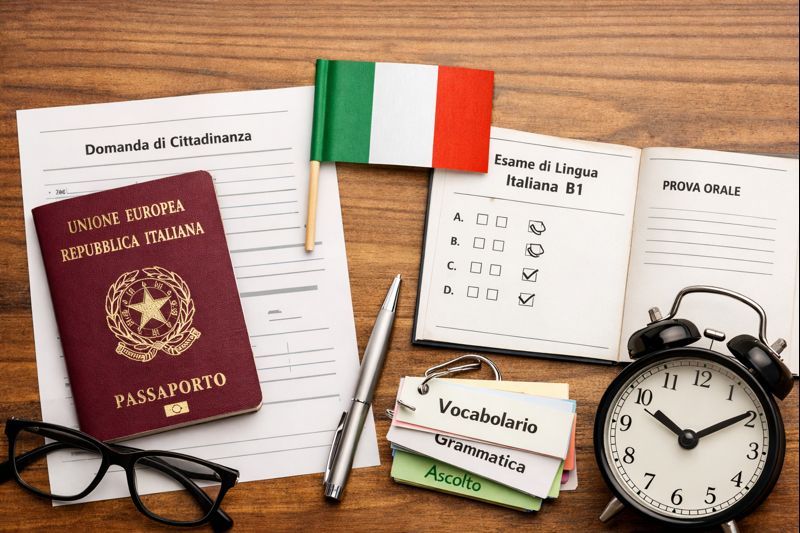
Italian Citizenship and the B1 Language Requirement
When people start thinking about Italian citizenship, language often becomes the most concrete and, at the same time, the most misunderstood requirement.
Since the 2018 Security Decree (Law 132/2018), demonstrating a B1 level of Italian has become a standard requirement for Italian citizenship applications, whether by residence or by marriage or civil union.
As a result, the language exam is now an unavoidable step in the process. What still creates confusion for many applicants is not if the exam is required, but how to approach it: which certification to choose, how long preparation actually takes, and how to prepare efficiently without turning the process into a purely academic exercise.
What creates confusion is not the level itself, but everything around it:
- Which exam is accepted?
- Where can you take it?
- How long does preparation really take?
- And how do you prepare efficiently without turning the exam into a purely academic exercise?
This article is meant to clarify those points, based on real experience preparing candidates for the exam, often under tight timelines and very specific bureaucratic constraints.
What the B1 requirement actually means
On paper, B1 is described as an “intermediate” level. In practice, for citizenship purposes, it means being able to:
- understand everyday spoken Italian
- handle predictable situations
- read and write simple but structured texts
- communicate clearly, even with mistakes
The exam does not test elegance, literary style, or advanced grammar. It tests whether Italian is functional for daily life and civic interaction.
This distinction matters, because it changes how preparation should be approached.
Which Italian language exams are accepted
For citizenship by residence, Italy recognises several official certifications, all considered equivalent at B1 level. The most common are:
- CILS (Università per Stranieri di Siena)
- CELI (Università per Stranieri di Perugia)
- PLIDA (Società Dante Alighieri)
- Cert.It (Università Roma Tre)
From a preparation point of view, these exams are very similar. The real differences are logistical rather than linguistic: where they are offered, how often sessions take place, and how long it takes to receive results.
This is why, when preparing candidates, the first step is often not language, but calendar.
Where and when you can take the exam
These exams are offered both in Italy and abroad, through authorised centres such as universities, cultural institutes, and certified language schools.
What matters in practice:
- exam sessions are usually scheduled only a few times per year
- registration deadlines are often several months in advance
- result delivery can take weeks or even months, depending on the exam
For this reason, preparation is always planned backwards from the exam date, not forwards from a generic study plan.
In my work, this timing aspect is just as important as the language itself. A well-prepared candidate who misses the registration window loses months unnecessarily.
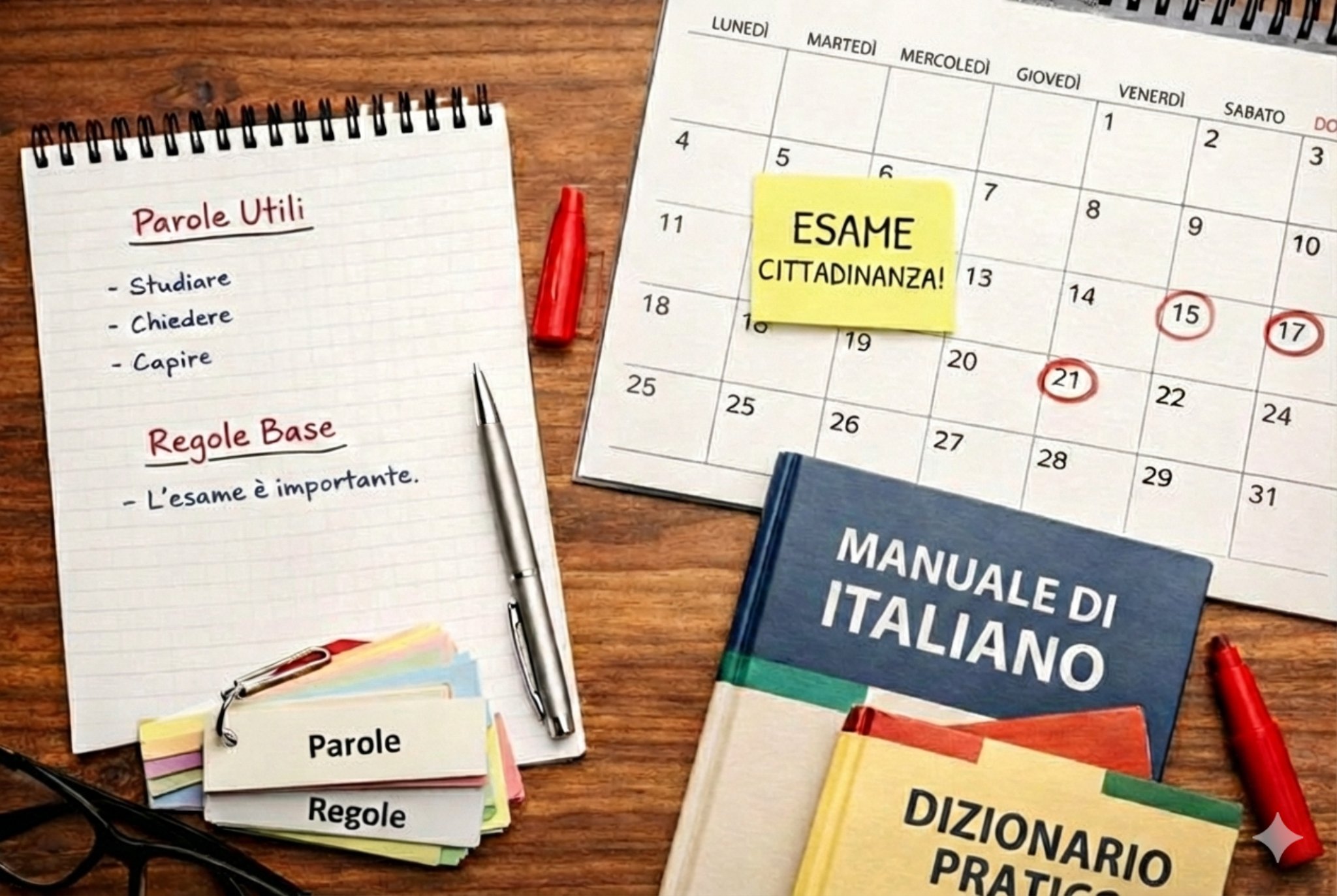
How long does preparation really take?
This depends almost entirely on the starting level.
- From A2 to B1: with consistent work, this is absolutely realistic within a few months. I’ve prepared many candidates successfully in this situation.
- From beginner level: the timeline is longer and requires a more structured path, especially for writing and listening comprehension.
What matters is not speed, but focus. Citizenship exams reward clarity and control, not breadth.
Preparing for the exam without studying “for the exam”
One of the most effective aspects of exam preparation is that it provides a clear framework.
For many learners, the citizenship requirement becomes a productive constraint: a reason to learn Italian in an organised, goal-oriented way. Vocabulary, grammar, listening and writing all develop together, because they are needed together.
This is how preparation should work: not memorising exam tricks, but building usable Italian within the structure of the exam.
The citizenship exam requires a balanced use of language: speaking clearly during the oral part, understanding written texts, handling grammar in context, and following spoken Italian that is closer to real life than to textbook examples.
For this reason, preparation works best when these skills develop together. Conversation supports confidence, grammar gives structure, listening sharpens comprehension, and reading and writing make the exam format familiar. When these elements grow in parallel, the exam stops feeling artificial and becomes a natural checkpoint in the learning process.
How we work with citizenship candidates
I’ve prepared many candidates for the B1 exam, who often have complex schedules, with strong motivation, and very clear deadlines.
Because of this, I’m extremely familiar with:
- the structure of the exams
- the official documents and tasks
- the type of language actually required
These materials are not treated as “test content”, but as working material for the lessons themselves.
Courses are always personalised, based on:
- the candidate’s starting level
- the chosen exam and location
- the available time before the session
This allows candidates to prepare efficiently, without wasting time on unnecessary or irrelevant language.
One recent example was a Brazilian applicant living in Germany, highly motivated and under time pressure. Thanks to his background in a related language and a focused, personalised preparation based on official exam materials, he was able to pass the CILS B1 exam on his first attempt within a few months.
Results like this are never automatic, but they show how a realistic strategy, combined with consistent work, can make the process far more manageable.
You can find more details about how this works in practice in our individual Italian courses, where preparation is always adapted to real goals and real timelines.
Italian citizenship as a learning opportunity
For many candidates, preparing for the citizenship exam becomes something more than a requirement. It becomes a structured way to finally improve and master their Italian.
Not perfect Italian. Not academic Italian. But Italian that works.
Ready to prepare with clarity
If you’re considering Italian citizenship and want to prepare for the language exam in a way that is realistic, structured, and adapted to your situation, a personalised approach makes all the difference.
If you’d like to discuss your starting level, exam options, and realistic timelines, you can book a free trial lesson.