Mastering Italian Vocabulary: Friends and False Friends for English Speakers
Why vocabulary feels harder than grammar, and how to change that
When adults start learning Italian, they often expect grammar to be the biggest obstacle. And yet, after a few months, many realise that grammar is manageable. Vocabulary less so.
The reason is simple: grammar has structure. Vocabulary feels infinite.
Most learners try to solve this by memorising lists of words. It rarely works. Words learned in isolation are easy to forget, not because the learner lacks discipline, but because that’s not how the brain stores language.
Vocabulary sticks when it is:
- used in context
- or connected to something you already know
For English speakers learning Italian, this second point is crucial. Italian and English share a vast amount of vocabulary with common roots. Some similarities are reliable and extremely helpful. Others look familiar but lead you in the wrong direction.
Understanding the difference is one of the most effective ways to build your vocabulary without drowning in word lists.
As an Italian native teacher working with adult learners, I see this problem constantly. Students often tell me they “know the grammar”, but feel blocked when it comes to vocabulary. Not because they haven’t studied enough, but because they’ve been trying to memorise words in isolation.
When similarity works in your favour
Once you stop looking at words individually and start noticing patterns, Italian becomes far more approachable.
A clear example is what happens with many English nouns ending in -tion. Very often, these words reappear in Italian with a predictable shape: -zione. And the good news is: they are consistently feminine nouns.
You don’t need to memorise a rule to benefit from this. You start noticing it naturally when reading or listening:
- Information → informazione
- situation → situazione
- tradition → tradizione
- organization → organizzazione
- conversation → conversazione
- competition → competizione
This isn’t a coincidence. It’s a structural connection between the two languages, and it’s one of the most powerful shortcuts available to English speakers learning Italian.
After a while, Italian texts stop feeling unfamiliar and start revealing recognisable structures.
At that point, vocabulary is no longer something you “study”. It’s something you recognise.
This is exactly the kind of pattern we focus on in individual Italian lessons. Instead of memorising single words, students learn to recognise structures they can immediately reuse in real contexts.
Other patterns worth noticing
The same logic applies to other word families. You don’t need dozens of examples, just enough to see the pattern.
Words ending in -ity in English often correspond to -ità in Italian. Once you notice it, possibility, activity or reality no longer feel new.
Similarly, adjectives ending in -al in English frequently become -ale in Italian: natural, cultural, personal. The meaning stays close, the form shifts slightly, and your brain fills in the rest.
These patterns matter because they reduce cognitive effort. You’re no longer memorising isolated items. You’re building a system.
When similarity becomes a trap
Of course, not all similarities are your friends.
Some words look reassuringly familiar but mean something quite different. These are the famous false friends, and they tend to cause problems precisely because learners trust them too much.
Take the verb to pretend. An English speaker instinctively reaches for pretendere in Italian. The result is confusion. In Italian, pretendere doesn’t mean “to fake”; it means “to demand” or “to expect”. So he pretended to understand becomes ha finto di capire, not ha preteso di capire.
The same thing happens with adverbs.
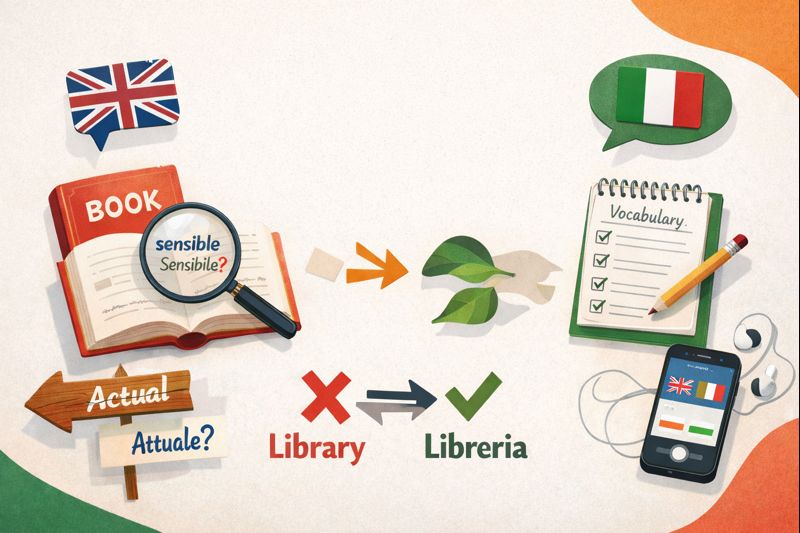
- Actually does not translate as attualmente. In Italian, attualmente means “currently”, while actually corresponds to in realtà.
This small mismatch is enough to change the meaning of an entire sentence. Other false friends appear early and persist for years.
- Library feels identical to libreria, until you realise that libreria is a bookshop, not a library.
Even advanced learners slip on this one, simply because the visual similarity is so strong.
These words aren’t dangerous because they’re rare. They’re dangerous because they feel safe.

How to work with false friends instead of fighting them
The goal isn’t to memorise false friends as a blacklist. That approach creates anxiety and slows you down. A better strategy is to notice them in context, understand why they mislead you, and move on. When you understand the mechanism behind the mistake, the correction sticks much more easily.
This is also why clusters work better than isolated examples. Your brain prefers systems over exceptions, even when dealing with mistakes.
Vocabulary isn’t a list, it’s a network
This way of working with vocabulary is at the core of how we approach Italian at Italian Teacher. Our personalised Italian lessons are built around context, patterns and real usage, not memorisation for its own sake.
At a certain point, learners realise that vocabulary doesn’t grow word by word. It grows through connections: between languages, between meanings, between contexts.
Friends and false friends matter not because they are tricks, but because they show you how Italian and English relate to each other, where they align and where they diverge.
Once you start learning vocabulary this way, something shifts. You stop asking “How do I memorise more words?” and start asking “How does this word fit into what I already know?” That’s when progress becomes steady instead of exhausting.
Want to build Italian vocabulary in a way that actually lasts?
In our lessons, vocabulary is never taught as a list to memorise.
We work with context, patterns, and mental connections that learners can reuse immediately.
If you’d like to experience this approach and see how it works for your level and goals, you can book a free trial lesson.