Sinterklaas, Santa Claus and Babbo Natale: A Shared Story
A cultural journey connecting the Netherlands, Italy, and the Mediterranean world
Every December, the Netherlands transforms. Children set their shoes by the fireplace, the evening news follows Sinterklaas’ arrival, and families prepare for pakjesavond on 5 December. For most Dutch people, the tradition feels deeply local, uniquely theirs.
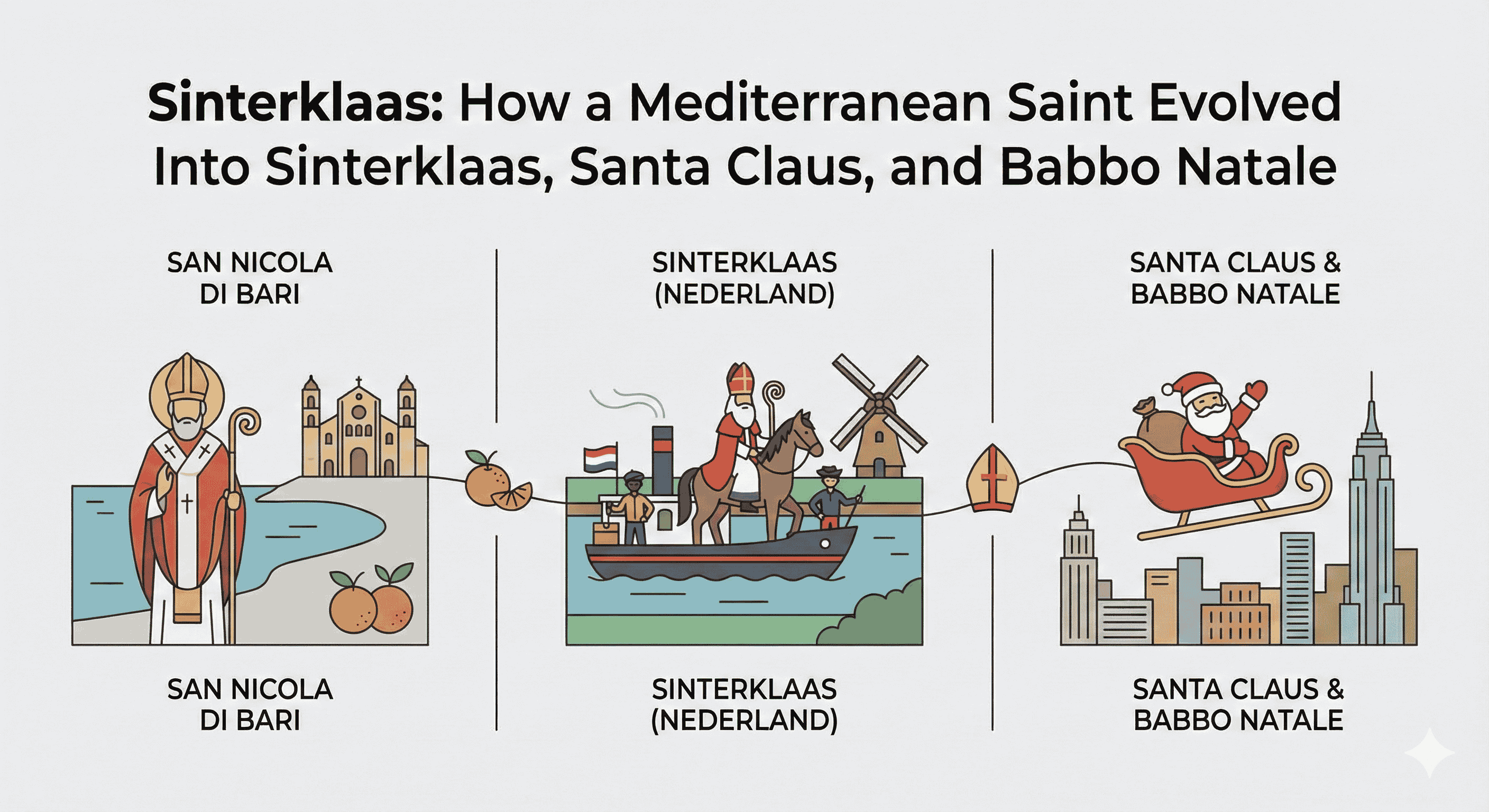
But if you look beneath the surface, you find a story that travels far beyond the Low Countries: from Myra in present-day Turkey, to Bari in southern Italy, through Spain, and eventually across the Atlantic to North America.
Sinterklaas isn’t “Italian” and he isn’t “Spanish”, but his story picks up fascinating layers from each of these places, through history, trade, legend, and 19th-century storytelling.
A personal note
As an Italian teacher living in the Netherlands, and as the father of a three-and-a-half-year-old, I recently found myself diving deeper into the origins of Sinterklaas. I wanted to explain the Dutch tradition to Italians who had never encountered it, and at the same time show Dutch friends how unexpectedly Mediterranean some elements of the story are. This blend of cultures is exactly why I enjoy writing pieces like this: language comes alive when you understand the stories behind it.
From Myra to Bari: where the story actually begins
The historical Saint Nicholas was a bishop from Myra, in what is now Turkey. His reputation for generosity spread across the Eastern Mediterranean, and centuries later merchants brought his relics to the city of Bari, turning it into a major pilgrimage site dedicated to San Nicola di Bari.
This Italian connection is real, but it doesn’t make Sinterklaas an “Italian tradition”. Rather, it shows how religious devotion and storytelling travelled through the ports and trade routes of the Mediterranean, before reaching northern Europe.
Why Spain, and sometimes even Italy, appear in the Dutch imagination
As the cult of Saint Nicholas reached the Low Countries, it blended with local folklore and medieval customs. But several historical details help explain why Dutch tradition places Sinterklaas “in Spain” and why southern Europe occasionally enters the story.
1. Bari once belonged to the Spanish Crown
From the 1500s to the early 1700s, much of southern Italy, including Bari, was ruled by the Spanish Empire. This geopolitical link helped create a mental map in which southern saints were indirectly associated with Spain.
2. Mediterranean trade and the arrival of citrus fruits
Oranges and mandarins, now iconic Sinterklaas gifts, reached northern Europe through Mediterranean trade routes. These fruits came from warmer regions and may have reinforced the image of a benevolent figure arriving “from the South”.
3. 19th-century Dutch children’s literature
The narrative of Sinterklaas coming from Spain was solidified in 19th-century books, not in medieval tradition. Spain offered an exotic, warm, believable homeland for a gift-bringing bishop.
None of this creates a direct origin story, but together, these elements explain why Sinterklaas carries subtle traces of Italian relics, Spanish history, and Mediterranean trade.
A cultural patchwork, not a straight line.
How Sinterklaas developed helpers, and where “Piet” fits in
As the tradition evolved in the Netherlands, Sinterklaas acquired helpers. These companions did not exist in the early legends of Saint Nicholas; they emerged much later, influenced by:
- medieval processions
- European folklore figures
- 19th-century storytelling
The figure known today as Piet belongs to this later layer of the tradition. His representation has changed significantly in recent decades, reflecting social conversations in the Netherlands and the ongoing evolution of the feast.
From Sinterklaas to Santa Claus
When Dutch settlers brought Sinterklaas to New Amsterdam (modern-day New York), he transformed into Santa Claus. Over time he adopted:
- reindeer
- a sleigh
- elves
- the North Pole
- and, eventually, his famous red suit
But beneath all the modern iconography remains a recognisable outline: a generous figure shaped by centuries of cultural adaptation, from Myra to Bari to Amsterdam to Manhattan.
Italy completes the circle: Babbo Natale, and the forgotten Befana
Italy did not originally celebrate Christmas with Babbo Natale. Gift-giving was spread across different traditions:
- San Nicola in the South
- Gesù Bambino in some regions
- and especially la Befana, who arrives on 6 January
The Befana: an Italian figure almost unknown in the Netherlands
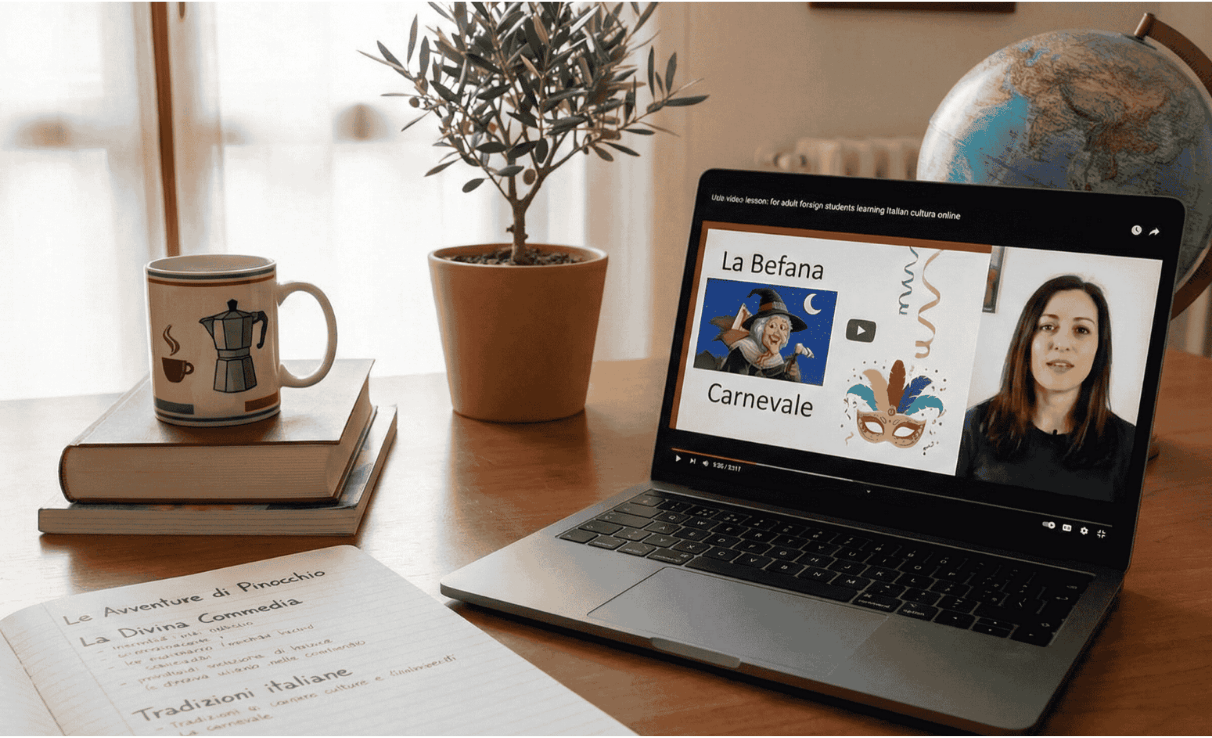
La Befana is an old woman who flies on a broom, bringing sweets or small presents. She marks the end of the festive season and represents domestic warmth and generosity. While she is deeply rooted in Italian culture, she remains largely unknown in the Netherlands, offering a fascinating contrast to Sinterklaas.
Only in the 20th century did Italy adopt Babbo Natale, inspired by the American Santa Claus (who originated from the Dutch Sinterklaas… who absorbed layers from Mediterranean history).
A wonderful example of cultural circularity.
A small preview: more cultural “episodes” coming
If you enjoy this kind of cultural deep dive, expect more on ItalianTeacher.eu. There are many traditions, curiosities, and historical connections between Italy, the Netherlands, and the wider Mediterranean that deserve their own small “episodes”. This article is just the beginning.
How to explain Sinterklaas in Italian
Here are a few phrases you can use when talking about the Dutch feast in Italian:
“In Olanda festeggiamo San Nicola il 5 dicembre.” In the Netherlands we celebrate Saint Nicholas on December 5th.
“I bambini mettono una scarpa e ricevono dei regalini” Children leave a shoe and receive small gifts.
“San Nicola è presente in molte tradizioni europee, ma ogni Paese le ha trasformate a modo suo.” Saint Nicholas is at the origin of many European traditions, but each country transformed them in its own way.
A short Italian dialogue about Babbo Natale
- Cosa vuoi ricevere da Babbo Natale? What would you like to get from Santa Claus?
- Vorrei un libro e un po’ di cioccolata. I’d like a book and some chocolate.
Why this cultural journey matters when learning Italian
Understanding how a Turkish bishop, an Italian shrine, Spanish history, Dutch folklore and American storytelling all contributed to our modern December traditions shows exactly how languages evolve: through movement, imagination and contact between cultures.
For learners, it means one thing: you don’t just learn Italian, you learn the stories that make the language meaningful.
Want to learn Italian in a way that connects language, culture and real communication?
Italian isn’t just grammar. It’s stories, traditions, rhythm and the way people actually speak.
If you’d like to learn with a method that adapts to your pace and goals, you can book a free trial lesson. We’ll look together at where you are now and how to build a learning path that really works for you.